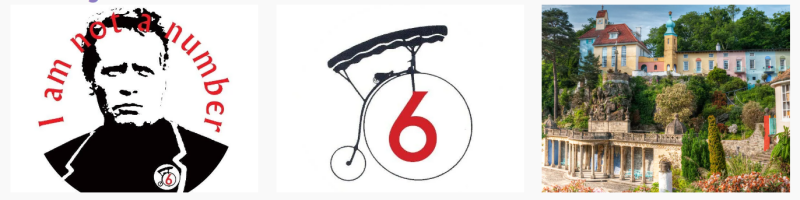
A 1960s TV series, a Welsh fantasy village I honeymooned in, and a question that still echoes through every workplace: why did you resign?
May 2026 : 5 min read - Part of the My Personal Journey to Early Retirement series
I've been watching The Prisoner again.
For anyone who hasn't seen it: 1967, ITV, Patrick McGoohan as a British secret agent who resigns abruptly, drives home angry, gets gassed by a man in a top hat, and wakes up in The Village. The Village looks like a charming Italianate seaside resort. It's also a prison. Nobody can leave. Everyone has a number instead of a name. McGoohan is Number 6, and the central question of the series, asked by a different Number 2 each episode, is: "Why did you resign?"
I'm 58, recently retired, and I have watched this show entirely differently than I did the first time around.
The bit that lands hardest
In the opening of every episode, No.6 asks his recurring questions to No.2.
"Where am I?" - Answer "In the Village", "What do you want?" - Answer "Information", "Whose side are you on?" - Answer "That would be telling."
"Who are you?" - Answer "The new No.2". "Who is Number 1?" - Answer "You are Number 6."
And the question that comes the other way, asked repeatedly by No.2 in various forms across the series: "Why did you resign?"
Towards the end of the series No.6 finally answers "For peace...For peace of mind." The words give No.2 precisely nothing he can use. The defiance is in giving them an answer that contains no information. Once he gives them the answer, the Village wins.
I had this question asked of me a lot in the months before I left. By HR, by colleagues, by senior managers in the corridor pretending it was a casual chat. The casual chat was never casual. They wanted to know the answer. They wanted to file it, understand it, mitigate against it for the next person. Like No.2, they had a slight smile and slightly too much interest.
McGoohan was braver than I was. He'd have said "For peace of mind" and let it sit there, the words doing none of the work they wanted.
I do have my own "for peace of mind" though. It's the answer I give to the question that comes after the resignation lands: "What are you going to do next?" I haven't quite accepted the word "retirement." I don't have a formal plan to recite. So I give them vagueness, polite warmth, change-of-subject. The words satisfy the form of the question and reveal nothing. McGoohan would recognise the technique.
The Village as the office
The Village is genuinely lovely. Pastel-coloured buildings, manicured gardens, a chess pavilion, a brass band. The administrative class are unfailingly polite. The aesthetics promise a kind of community. No.6 isn't in chains. He's in a comfortable cottage with a stocked fridge and freshly delivered milk.
This was the bit I didn't appreciate at age 22. Now I do. The corporate Village isn't a sweatshop. It's an office with good coffee and an ergonomic chair, a "we're a family" culture, a wellness app, a thriving employee resource group. All the surface signs of being a pleasant place to be. None of which changes the fact that you can't leave whenever you want, your time isn't yours, and the people who run it have an information requirement they've not stopped pursuing.
It got worse, not better, when working from home arrived. The promise was freedom from the commute and the office. The reality was being chained to your desk by back-to-back Teams calls, with no walk-and-think time between meetings and no boundary between the Village and your own house. No.6 had a comfortable cottage in the Village. By the end of my career I had No.6's cottage too. The Village had moved in with me.
The Penny Farthing emblem of the Village is the corporate logo on the name-tag. Different shape, same function.
Number 2 keeps changing
A different No.2 runs the Village every episode. They vary in style and approach. Some are jovial, others stern. A few try to befriend No.6 before pivoting to interrogation. The job description is identical regardless. Extract information, prevent escape, maintain the system.
Across a long career you meet a lot of No.2s. They have business cards instead of opera capes. Their styles vary. Their job description is identical. Their motivations are the same. The questions they ask are the same. The system is bigger than any individual occupying the role, and No.2 turnover doesn't change the system at all.
Portmeirion
The Village was filmed at Portmeirion, the Italianate fantasy village on the north Welsh coast designed by Clough Williams-Ellis between the 1920s and 1970s. It's a real place. You can stay there.
My wife and I went there for our honeymoon, more than twenty years ago. Our 18-month-old daughter came with us. We'd just bought our first house together, and the trip felt like the start of something new. I was, at that point, the version of me who would later become No.6 without realising it. We walked the same paths McGoohan walked. Ran across the same beach where No.6 tried to escape. Took the same photos. The buildings haven't changed.
I didn't see it as a prison then, obviously. I saw it as a beautiful absurdity, a film set you could live in for a few days, somewhere to start a marriage. It is still all of those things.
But there's something quietly funny about realising, two decades later, that you honeymooned in the location chosen by a paranoid Irish actor as the perfect setting for a story about corporate captivity. We picked it for the surrealism. Turns out McGoohan picked it for almost the same reason.
The escape
No.6 spends seventeen episodes trying to escape. He builds rafts, impersonates other characters, attempts to take over the Village from within. Every escape fails. Rover, the inexplicable white balloon, drags him back.
The final episode resolves in a surreal dream sequence that's been interpreted a hundred ways. Some people read it as No.6 finally escaping. Others read it as him never leaving.
I had my own version. Years of thinking about it. Eighteen months of planning. Spreadsheets opened and closed and re-opened. Scenarios modelled at various exit dates, draw-down rates, market crash assumptions.
I thought about leaving several times before I actually did. Each time something pulled me back. A bonus about to land, a market dip, the global uncertainty, then the voice that said "one more year, just one more, and then you'll have enough, then you'll be free." Rover, dragging me back into the Village every time I thought I could escape.
The interpretation I prefer, now that I'm out of my own Village, is that the escape was never really geographical. The Village was a state of mind. What changed wasn't where No.6 was. It was that he stopped accepting the premise.
I had the same moment, less dramatically. There was no defining episode, no white balloon I outran.
What there was, eventually, was a quiet recognition that the premise wasn't true. One more year wouldn't make me feel ready. The spreadsheets wouldn't deliver certainty, and the bonus wasn't worth it. The Village had been running my decisions on its own logic, and I'd been letting it. Once I stopped accepting that, the rest was timing.
I gave them the answer they wanted to hear when I resigned. McGoohan would have done it differently.
The result was the same. I'm not in the Village any more.
Finally "I am not a number, I am a free man!"
Be seeing you.
Further reading:
- I Still Can't Quite Say the Word - My Complicated Relationship With "Retirement"
- The Two-Phase Problem: Why Planning Retirement Isn't the Same as Living It
- Deciding to Retire Early - I've Done Everything Right. So Why Am I Still Scared?
Part of the My Personal Journey to Early Retirement series
Tony writes about his personal journey to early retirement at freebefore65.co.uk.
Add comment
Comments