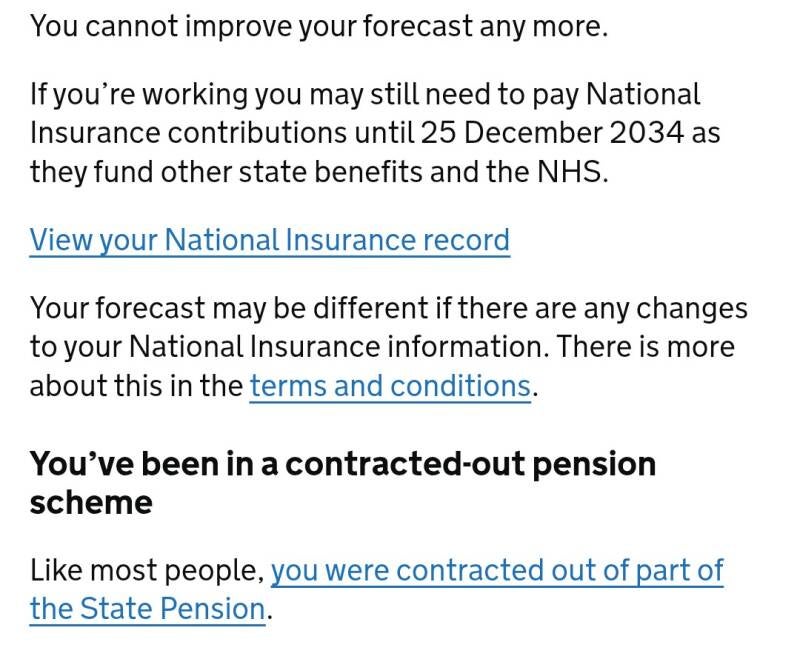
Check your State Pension forecast and there's a fair chance you'll hit a line that says you were "contracted out" of part of the State Pension, alongside something called a COPE deduction. It sounds like you've been short-changed. For most people, mine included, it works out to nothing lost, and here's why.
August 2026 : 6 min read - Part of the FreeBefore65 UK Retirement Planning Basics series.
I was reading an online thread about pensions this week when contracting out and SERPS came up, terms I half-recognised and couldn't have explained. So I checked my own forecast, saw "you were contracted out of part of the State Pension", felt the small lurch of "hang on, have I lost something", and went to find out. It turns out the answer is reassuring, but the way it's presented almost invites you to panic. So this is the plain-English version I wish I'd had to hand.
What contracting out actually was
Before April 2016, the State Pension came in two parts. The basic State Pension, and an earnings-related top-up called the Additional State Pension, known as SERPS and later as the State Second Pension, or S2P.
You could contract out of that second part. If you did, you and your employer paid lower National Insurance, and in return you stopped building up the Additional State Pension, because you were building a workplace pension instead. Most people in final-salary schemes, and many in other workplace pensions, were contracted out, often without ever really noticing. If your old payslips show a National Insurance category letter of D, E, L, N or O, that's what it means. Contracting out ended when the new State Pension began in April 2016.
The important thing to hold onto is that the lower NI you paid didn't vanish. It went towards your workplace pension. You weren't paying less for nothing. You were paying less into the State Pension and building the equivalent up somewhere else.
Why your forecast shows a deduction, and why it isn't what it looks like
When the single new State Pension launched in April 2016, the government had to be fair to everyone who'd built up entitlements under the old rules. So for anyone with a National Insurance record before that date, it did two sums.
One worked out what you'd built under the old system, the basic plus the additional, with an adjustment for the years you were contracted out. The other worked out what you'd have under the new rules. It took whichever was higher as your "starting amount" for the new system. If that starting figure came out below the full new rate, you could then build it back up by earning qualifying years after 2016, with each year adding 1/35th of the full amount.
The figure that alarms people is the COPE, the Contracted Out Pension Equivalent. It's worth being precise about what it is, because the wording is misleading. COPE is not money taken off your State Pension after it's paid. It's an estimate of the Additional State Pension you gave up, which the government expects your workplace pension to be paying instead. As MoneyHelper puts it, it's a signpost that says "look for that part of your pension over here, in your workplace scheme", not a penalty. You gave up one thing and got another in its place.
What it means in practice, using my own forecast
Here's the reassuring part, and the government's own figures back it up. Over 80% of people would reach the full new State Pension, or more, once their post-2016 years are counted, even after contracting out is taken into account.
My own forecast is the worked example. I was contracted out for years, and my forecast still shows the full new State Pension, with a note that this is the most I can get and I can't improve it further. That's the system doing exactly what it's designed to do. Contracted out for a stretch, which lowered the 2016 starting figure, then topped back up to the maximum through the qualifying years I earned afterwards. The contracting out is now just history that explains a line on a statement. It costs me nothing in the end. And I got the other side of the bargain too, the workplace pension those lower NI years were building.
The one thing not to do
If your own forecast shows you're already at the full amount, there's nothing to fix and nothing to buy. You can't improve on the maximum.
And here's the trap the forum threads push people into: do not rush to pay voluntary National Insurance just because you see the word "contracted out". For some people, filling gaps with post-2016 years genuinely lifts their forecast. For others, especially anyone already at or near the full rate, it adds little or nothing, and the money is wasted. The only way to know is to look at your own forecast and see whether you're already maxed out or have room to grow. Check first, top up second, and only if the numbers actually say so.
So if that "contracted out" line gave you a jolt, do what I did. Read your forecast to the end, find the figure it says is the most you can get, and see where you actually stand. For most of us who spent a career in workplace schemes, the alarming deduction turns out to be a 2016 accounting step that later years quietly undo.
Further reading
- Pensions & National Insurance
- Go to gov.uk and search "Check your State Pension forecast." It takes five minutes.
Part of the FreeBefore65 UK Retirement Planning Basics series. Start with the Master Checklist if you're new here.
Tony writes about his personal journey to early retirement at freebefore65.co.uk. He is not a financial adviser. All content reflects his own experience and research and should be taken as a starting point for your own thinking, not as professional advice. Always confirm with the Future Pension Centre before making voluntary NI contributions.
Add comment
Comments